
When the legendary investor Joel Greenblatt urged investors to go off the beaten path because that’s where the good opportunities hide, I’m not sure he meant watching hours of Virtual Youtuber (VTuber) livestreams, VTuber concerts, and VTuber game shows. Well… I did exactly that. I’m pretty sure I found a hidden gem (at least for most Western investors). I also learned, with high confidence, that VTuber content isn’t my cup of tea after all.
But the rabbit hole was still worth it, because once you stop treating VTubers as “streamers with anime faces,” you realize you’re looking at something closer to a new kind of entertainment IP machine.
Anycolor isn’t just managing creators. It’s running a character-IP franchise business that looks closer to a modern entertainment studio like Disney and DreamWorks than a typical talent agency. The key difference is structural: the “mask” is the product. And that mask is not just a face-cover. It’s a persistent identity with a visual language, personality, lore, and a vibe that fans attach to.
In a classic long-tail market defined by winner-take-most at the top and endless niches in the fat tail, I believe Anycolor has chosen the more robust strategy. That’s why I’m comfortable calling it a high-quality compounder at a valuation that still feels reasonable.
This post lays out the thesis.

What Nijisanji is, and how Anycolor makes money
Nijisanji is the flagship brand under Anycolor: a large roster of VTuber talents who stream, perform, collaborate, and build fandoms under a unified umbrella.
The typical VTuber agency model works like this:
Talents apply to join an agency.
The agency provides training, production support, managers, moderation, and coordination.
The agency provides distribution leverage: a built-in audience, cross-pollination between talents, and a platform-like ecosystem that pushes discovery.
Importantly, VTuber agency constructs a bespoke avatar and identity for the talent, think personality, lore, and genre.
Now the crucial VTuber twist: fans aren’t just bonding with a “person streaming with a webcam.” They’re bonding with a human-avatar hybrid character that evolves organically, often beyond what either a human or machine can create on its own.
That identity is powered by increasingly affordable technologies:
2D/3D computer animation
Real-time motion capture
AR live performance capabilities
As these technologies become better, faster, and cheaper, operating a VTuber platform is more scalable than ever before.
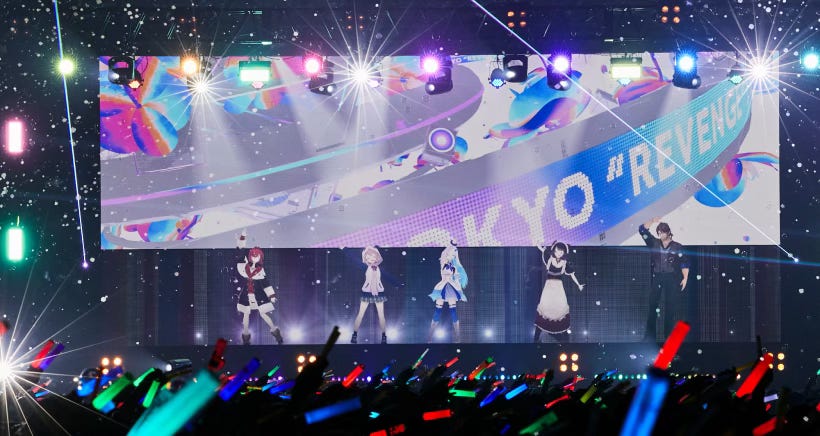
Over time, the avatar becomes a portable brand container that can be monetized across channels: content, merch, events, sponsorships, and other fan-oriented products.
One more structural point that matters a lot for the business model: unlike traditional entertainment where a performer can often leave an agency and keep their personal brand intact, VTuber agencies typically maintain far stronger leverage over the “character” identity. When a talent leaves, they generally cannot just take that same character IP with them and continue as-is. The switching cost is huge because “starting over” means rebuilding an identity, a content graph, and a fandom.
That leverage is uncomfortable for some people (and we should name that openly), but economically it creates a very real lock-in dynamic that doesn’t exist in most creator ecosystems.
The industry: from Japan’s internet to global mainstream
VTubing came out of Japanese internet culture in the mid-2010s and became mainstream in Japan in the next decade. By 2020, the category has matured into a full stack of content formats: gaming, music, comedy, variety shows, live concerts, brand sponsorships, and more.
Today, there are two dominant players in the agency model:
Cover Corporation (best known for Hololive Production)
Anycolor (best known for Nijisanji)
There are plenty of smaller and emerging agencies in South Korea and China (among others), but they’re sub-scale relative to the top two. Business models rhyme across the category, so focusing on the leaders is a clean way to study the structure.
Tale of Two Agencies: “focused idols” vs “diversified portfolio”
Cover / Hololive (as it is commonly perceived, especially overseas) has leaned into a more “idol + music” orientation with a tighter set of highly prominent tentpole talents and major moments. When it works, it’s extremely powerful: high per-talent output, massive merch/event monetization, and strong international brand recognition.
Anycolor / Nijisanji has taken a different route. It looks less like a tightly curated idol group and more like a multi-category portfolio:
Idols and musicians
Comedians and talk-show styles
Competitive gamers
Collab-heavy social streamers
Niche anchors that may never be “global famous,” but are deeply beloved inside their community
This matters because the VTuber market behaves like a long-tail distribution. A small set of talents will always dominate view counts and mindshare, but the real surface area of fandom is spread across a fat tail of niches. The tail is where people find “their person,” and once they do, they stick.
If you accept the long-tail premise, Anycolor’s strategy is basically: own more niches, more consistently, with more redundancy.
Anycolor’s Moat: switching costs + portfolio anti-fragility
1) The agency has unusually strong leverage over the talent identity
As discussed earlier, the character-based identity is hard to port. Leaving often means losing the thing the audience actually bonded with: that exact “mask” and the social graph around it. That creates switching costs that are rarer in the broader creator economy.
2) Anycolor’s roster strategy creates robustness
Graduations and retirements are inevitable in this business. People burn out. Life happens. Scandals happen. Tastes shift.
If your revenue is concentrated in a handful of superstars, your business can look amazing until it suddenly doesn’t. Volatility is the tax you pay for concentration.
Anycolor’s larger cohort strategy acts like a steady cash-cow portfolio:
One talent can decline or quit without breaking the company
Multiple niches can grow independently
The company can replenish the roster over time without relying on a tiny set of perfect bets
Some people interpret “more revenue per talent” as superior efficiency. That’s true in a narrow sense. But in an industry with constant churn and unpredictable hit dynamics, I’d rather own a business designed to be resilient than one that requires consistently big and accurate bets to keep compounding.
This is what I mean by anti-fragility: you don’t need everything to go right for the business to keep working.
Why I think the stock is attractive
Here’s the simple version of the investment case:
Structurally robust strategy in a churn-prone category: diversified roster reduces single-talent concentration and revenue volatility.
Founder-led with real skin in the game: founder Riku Tazumi still owns ~40% of Anycolor (as of this writing).
High-quality economics: 60–70% ROIC.
Bulletproof balance sheet: ~¥22B net cash.
Good capital allocation: repurchased ~¥10B of shares in 2024 when the stock was near all-time lows; shifted toward dividends in 2025 after the stock rebounded.
Undemanding valuation (near historic lows): ~18x P/E and ~12x EV/EBIT.
This combination has all the right ingredients. The market often prices entertainment/creator companies like fragile hit factories. Anycolor is closer to a scaled, repeatable portfolio model with strong control points.
The risks
No thesis is complete without naming what can break it.
Talent relations and reputation risk
This is a people-driven business. If management over-optimizes for monetization and under-invests in talent well-being, you can trigger a slow bleed (low morale → high churn → eroding brand → lower monetization). Even if the IP is controlled, the human factor still matters.Platform dependence
Even with omni-channel monetization, a lot of attention still routes through platforms like YouTube. Policy changes, algorithm shifts, monetization rules, or cultural backlash can disrupt the business overnight.Pipeline dilution risk
Scaling a roster can lower average quality if the support system (training, management bandwidth, production) doesn’t scale with it. Portfolio only works if the platform keeps producing and maintaining appealing characters.Overseas execution risk
Expanding outside Japan isn’t just translation. It’s cultural fit, moderation, community management, and the ability to build local relevance without breaking what made the brand work. It took decades for K-pop to find success in the US, why would it be any easier for VTubers?
Bottomline
To be clear, this isn’t a “Cover is bad” post. Cover has built an incredible brand and has a strategy that clearly works.
But if you force me to choose, I’d rather own the business designed to survive imperfect outcomes.
In a long-tail entertainment market where churn is guaranteed and hit-making is never fully controllable, Anycolor’s diversified portfolio strategy looks more durable to me than a model that relies on consistently creating and maintaining a small set of mega-stars.
At ~18x P/E with net cash and 60–70% ROIC, that durability is exactly what I want to pay for.
Disclaimer:
The information provided in this content is for informational and educational purposes only and should not be construed as financial or investment advice. The opinions expressed are those of the author and do not constitute a recommendation to buy or sell any securities or financial instruments. While efforts are made to ensure accuracy, the information may become outdated or incomplete over time. Investing involves risk, including the potential loss of principal. Always conduct your own research or consult with a licensed financial advisor before making any investment decisions. The author may hold positions in the securities discussed.