
AI represents the greatest wave of innovation in decades. A 1991 computer simulation of evolving strategies shows what faster innovation does to dominant players, and it holds lessons both for the companies we own and for how we invest in them.
No One Wins the Prisoner’s Dilemma
The prisoner’s dilemma is a core model of cooperation and conflict, used across game theory, economics, and biology. One line of research asks which strategy performs best against all others. In 1980, the political scientist Robert Axelrod ran tournaments in which strategies submitted by researchers played one another repeatedly. Some were simple, such as “always cooperate” or “always defect.” Others were more sophisticated, such as tit-for-tat, which copies the opponent’s last move. Because Axelrod’s tournaments used a fixed roster, they couldn’t show how strategies arise, spread, and displace one another over time.
In 1991, Kristian Lindgren filled that gap with an agent-based simulation in which strategies compete, reproduce or die, and mutate. A mutation could alter a strategy’s decision tree, and every strategy occasionally made errors to simulate noise. In each generation, every strategy played several rounds against its neighbors, and the high scorers took over the low scorers’ territory.
The results followed a cycle. One strategy would dominate the population for a long stretch until a new mutant emerged and toppled it. The stable order then gave way to a period with no clear leader, in which many strategies vied for dominance. Eventually one outperformed the rest and took over, and the cycle began again.
I recreated Lindgren’s simulation to see how the mutation rate, a stand-in for innovation, affects how long winners last. In the figures below, the x-axis shows generations and the y-axis shows each strategy’s share of the population. Each run lasted 50,000 generations.
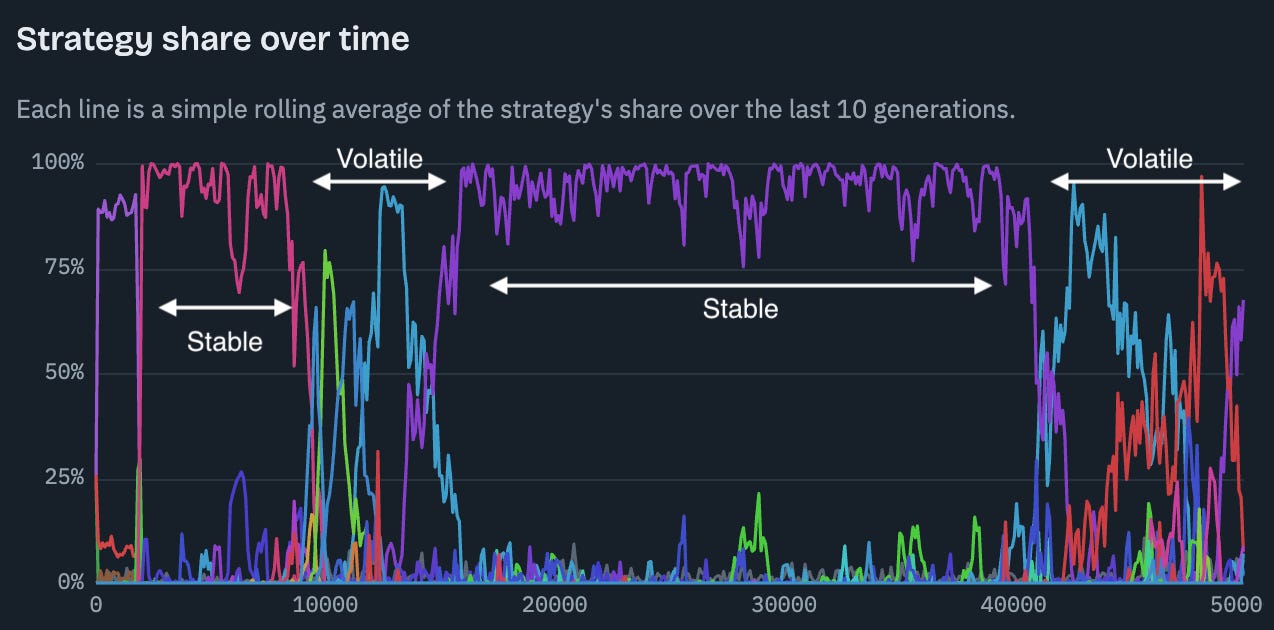
Fig 1. Mutation rate at 0.05%. Each color represents a distinct strategy.
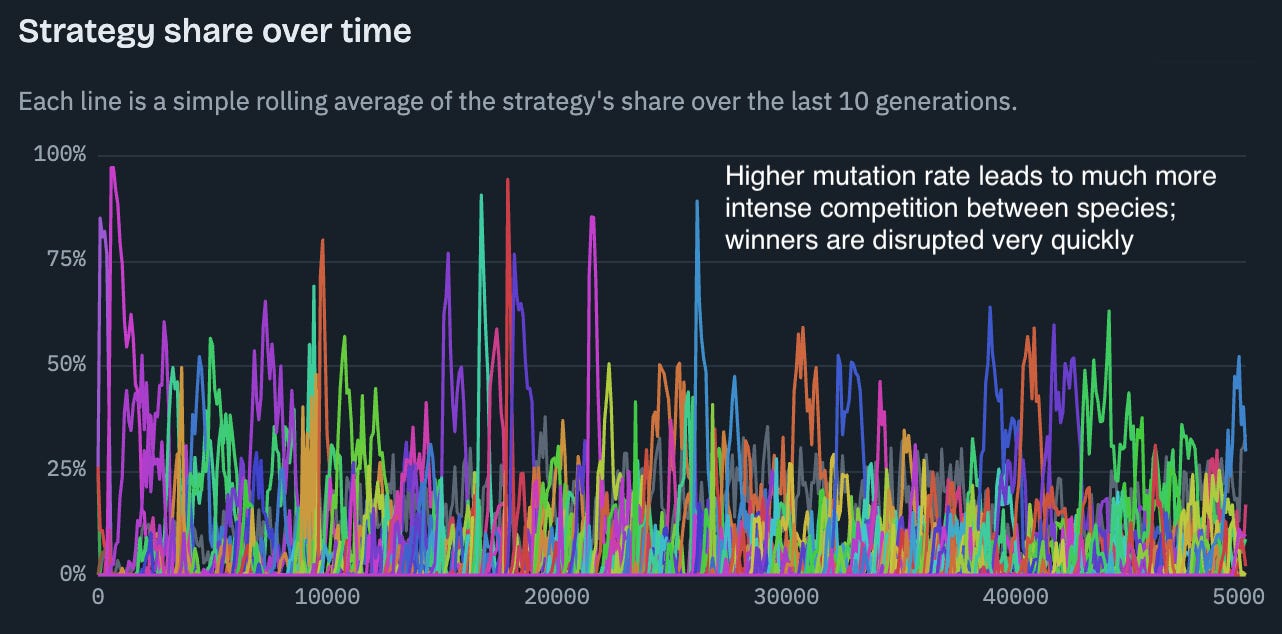
Fig 2. Mutation rate at 0.15%. Each color represents a distinct strategy.
The mutation rate sets the tempo. When mutations are frequent (Fig 2), the world stays turbulent most of the time: leaders do not last, and new entrants keep appearing. When mutations are rare (Fig 1), stable eras can last tens of thousands of generations, but the cycle of stability and upheaval persists.
Business competition shows the same pattern: there are periods in which a dominant business model earns outsized returns, broken by episodes of rapid turnover when a disruptive strategy shuffles the entire market structure. Clayton Christensen described why in The Innovator’s Dilemma (1997): incumbents rarely fall because they are badly run, but because the strategy that made them success leads them to ignore newcomers serving customers they don’t value.
From Simulation to the Real-World Economy
In The Origin of Wealth (2006), Eric Beinhocker extends the idea that the economy is an evolutionary system. Because many interactions between economic agents resemble Lindgren’s games, he argues, the economy never settles into equilibrium, and no strategy dominates forever. Fitness is always relative to a landscape that keeps shifting.
Beinhocker’s thesis is that “wealth is patterns of matter, energy, and information that satisfy human needs.” Business plans act as the economy’s DNA. Ford’s plan for the Model T, for example, combined a physical technology (internal combustion engine), a social technology (assembly line), and a strategy (affordable car for the masses). Markets create wealth by generating variety among these plans, selecting the fit ones, and amplifying them.
A core question for long-term investors is which businesses will thrive for decades and which will collapse in a downturn or fall to new entrants. Many investors treat high return on capital and a wide moat as the strongest signals of quality. Neither guarantees longevity.
Yellow-pages publishers once dominated their towns through local network effects: more readers attracted more advertisers, and more listings attracted more readers. Each local market was winner-take-all. The publishers earned high returns on invested capital, because a directory at scale needs little incremental capital. They earned high margins, because each additional ad cost almost nothing to print. And network effects gave them a wide local moat. An investor screening for quality would have found them.
Then search engines like Google let anyone find goods and services anywhere, creating a network effect no printed directory could match. The rise of search engines was the extinction event for the yellow pages. These businesses once looked impossible to challenge.
Return on capital and moats measure how well a business fit the landscape it grew up in. They say little about whether it will fit the next one. The deeper driver of quality is value creation: how well a business meets its customers’ needs compared with every alternative they have, including ones that don’t exist yet.
Why does this matter now? For two decades, one species of company has dominated the stock market: internet companies. They won the last paradigm shift and tightened their grip as documents moved from paper to digital, media from TV and DVDs to streaming, and customer interaction from desktop to mobile. These giants look impossible to challenge, protected by high switching costs, network effects, and economies of scale.
Like the dominant businesses before them, today’s winners could be the next species to face extinction. I won’t speculate on how an AI economy will evolve. Instead, I’ll focus on what tells an investor more than return on capital or moats.
Winning Strategies Change, but Business Quality Is the Same as Ever
Everything changes, so I find it more useful to ask what doesn’t. If we treat the economy as a complex adaptive system that selects winners through evolution, three principles emerge.
Value comes from meeting human needs. Companies that profit from zero-sum behavior, extracting value from shareholders, suppliers, employees, or customers rather than creating it, will have to change or be crushed by selection pressure. Some investors consider price increases as a sign of pricing power, but when incumbents often raise prices without adding value, customers leave gladly once a credible alternative appears. Switching costs slow customers down, not forcing them to pay rent forever.
Winning tomorrow matters more than winning today. Since winning strategies are displaced all the time, investors should watch how a company’s people behave over the long term. The signs are a culture where managers and employees are incentivized like owners, where staff at every level take initiative to delight customers, and where leadership will accept short-term criticism to build long-term value.
Slow-changing sectors enjoy longer stable eras, not immunity. Heavily regulated fields such as healthcare and banking change slowly, as do commodity sectors such as airlines and mining, where low base-rate returns on capital discourage new entrants. These sectors resemble Fig 1: a low mutation rate stretches stable eras but never ends the cycle. That stability may help explain why Warren Buffett has long avoided fast-changing industries. Ambitious entrepreneurs still arrive; they just take longer to break through.
Nick Sleep and Qais Zakaria of the Nomad Investment Partnership saw these principles play out in two of their best investments, Costco (2002) and Amazon (2005). Both companies put customer experience ahead of near-term profit, had managers who behaved well “because they want to, not because they have to,” and built an ownership culture that rewarded long-term value creation. None of this is specific to AI. These principles describe how businesses create value in any era.
Lessons for Investors
The same logic applies to investors themselves. The stock market is a complex adaptive system, one in which returns decide which strategies survive. AI is likely to trigger the next extinction event, wiping out many of the strategies that dominate Wall Street today.
To see which strategies are at risk, start with where an investor’s edge comes from. Bill Miller sorts it into three categories: information, analysis, and behavior.
Information and analysis now point at the same target: the business’s DNA. That means the business model, the integrity of the people running it, and their discipline on costs. Like the principles above, DNA resists quantitative screening, because judging it requires knowing how a business actually operates. Research centered on next year’s EPS growth or the size of the buyback program studies the surface of a company, and the surface is what AI now reads for everyone.
Information. The informational edge was always fleeting, because every new data point draws a crowd of analysts. The internet made most public data readily available. AI goes further, handing retail investors information that once took weeks to assemble, such as industry best practices, brand reputation, and expert opinion. What stays scarce is research that takes legwork, and Li Lu’s 1998 research on Timberland shows how far that legwork can go. The stock traded at about six times earnings with no sell-side coverage, the founding family controlled nearly all the votes, and a string of shareholder lawsuits made management look suspect. To find out whether the suspicion was deserved, Li investigated the family the way a journalist would. When he learned that the founder’s son and likely successor sat on the board of a nonprofit, Li joined that board, got to know the son, and concluded the family was trustworthy. He also visited Timberland’s stores, where managers complained they couldn’t keep enough inventory. None of this came from an SEC filing, and no prompt could have produced it.
Analysis. AI is getting good at standard analytical work. An army of analysts running sophisticated DCF models offers little advantage when a retail investor can build a similar model with a single prompt. When everyone has an AI analyst, that kind of analysis becomes table stakes. Fundamentals-focused investors gain more by examining a business from as many angles as possible, and analogs are one of the best tools for it. Near-field analogs, drawn from the same or adjacent industries, show how a business model performs under similar economics. Far-field analogs from distant domains such as biology or network science expose dynamics that every company in an industry shares, which peer comparison can never reveal. Lindgren’s simulation is one: it describes no industry, yet it explains why moats erode.
Risk deserves the same attention. Standard forecasting models fold risk into a discount rate, but guessing the right WACC tells you little about how a business could fail. The time is better spent assessing financial fragility, the durability of the moat, and management’s long-term incentives.
Behavior. Information and analysis help an investor understand a business; the behavioral edge faces inward. To make better decisions, investors must recognize and counter their own biases.
My favorite techniques for testing an investment thesis are the pre-mortem and the red-team exercise. A pre-mortem assumes the investment has failed and works backward to explain why. In a red-team exercise, one side attacks the thesis while the other defends it. Writing each assumption in a form that evidence could disprove keeps the thesis honest. Annie Duke’s Thinking in Bets and Michael Mauboussin’s More Than You Know cover these practices in more depth.
Selling is perhaps harder to master than buying, because it demands two traits that seem to conflict. An investor must stay open-minded enough to sell when new information breaks the thesis, and steadfast enough to hold when only the price has moved. The skill lies in telling the two apart: information that changes what the business is worth, and noise that changes only what the market will pay for it today.
Buffett and Munger ranked temperament above intellect and underscored staying within your circle of competence. Knowing what you own makes it easier to stand your ground when others panic or chase the hottest stocks. Some investors seem born calm. When Munger was asked how he felt buying stocks during the 2008 financial crisis, he said, “I felt nothing, not even one bit.” Others train for it. Ray Dalio, the founder of Bridgewater Associates, has practiced transcendental meditation since 1969 and credits it more than anything else for his success. I’m still a novice, but even simple breathing exercises have helped me manage stress and anxiety.
When every investor has an AI assistant to supercharge research and analysis, the behavioral edge will become even more important. While technology can support some of these behavioral exercises, every investors must practice to build and refine their mental game. Peter Lynch said that investors cannot borrow conviction. I believe he would say the same about temperament.
AI Is a Silver Lining for Fundamentals-Driven Investing
If most investors use the same few models to research, analyze, and decide, AI may breed a market monoculture. Markets correct themselves well when participants think differently. Michael Mauboussin, building on James Surowiecki’s The Wisdom of Crowds, argues that a crowd is wise only when its members’ errors are diverse enough to cancel out. When everyone leans the same way, the errors worsen. That is how the wisdom of crowds turns into the madness of crowds, and why a homogeneous market tends to be less efficient and more volatile.
Here lies the irony. AI has given everyone access to more intelligence, yet if everyone uses the same LLMs the same way, Mr. Market may think less clearly. Lindgren’s simulation suggests what comes next: a population dominated by one strategy is ripe for disruption by contrarians.
Much of the fear about AI centers on machines replacing human investors. However, a market that thinks alike will misprice assets more often and more severely, and the rewards will go to investors who do the legwork, understand a business’s DNA, and have the temperament to zig when the crowd zags for the wrong reasons. For fundamentals-driven investors, that is the silver lining.
Sources:
The Origin of Wealth by Eric Beinhocker
The mutation rate point is the one that stuck with me. A small error rate keeps the system learning without it falling apart.